Imagine a bull charging with its horns protruding upward and forward. A “bull market” is one in which sellers rule the market and prices are rising continuously.
Key characteristics of a bull market
A bull market is typically viewed by investors as a favorable trend. These are its primary attributes:
- Rising asset prices.
- Investor confidence.
- Economic growth.
- Low unemployment.
- High trading volume.
- Positive sentiment.
- Increased mergers and acquisitions.
- Low interest rates.
A bull market happens when the political and economic climate is favorable. It’s a time of development and self-assurance driven by positive news. However, positive tendencies are short-lived, and the market frequently experiences sharp reversals. However, as history demonstrates, the market has a tendency to heal itself, producing new growth and chart slopes with new highs that surpass the previous ones and new lows that never return to the earlier levels.
An example of a bull market
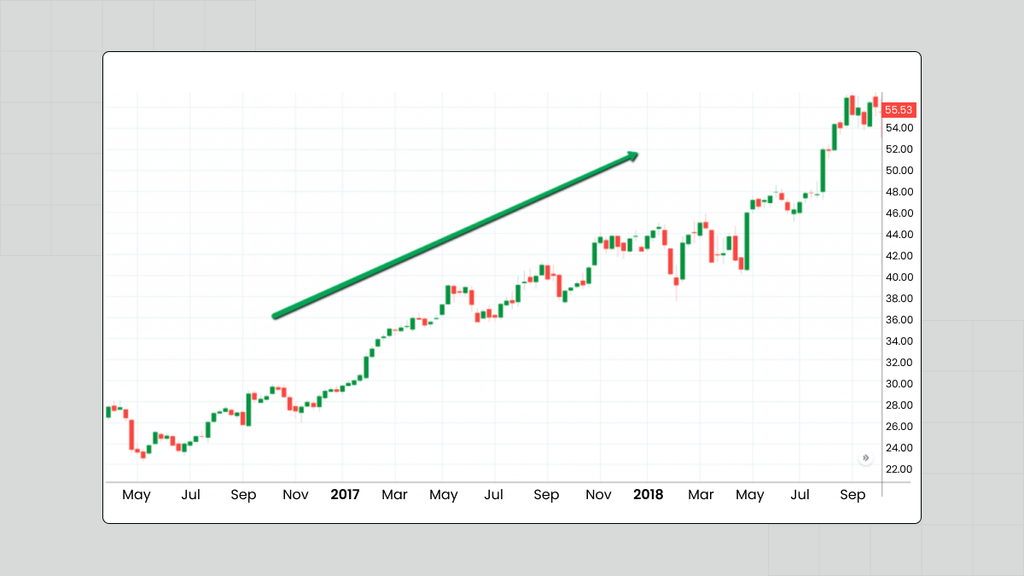
A bullish trend may be seen in the two-year APPL chart’s consistent inclination.
Another illustration is Bitcoin, which is likely the most popular cryptocurrency in the world and is well-known for its abrupt behavioral shifts. Here, BTCUSD is exhibiting notable positive patterns interspersed with abrupt declines—bearish movements, which are the antithesis of a bull market.
In trading, this occurs frequently.
How long does a bull market last?
A bull market may persist for several months. However, a bullish trend always ends with a negative one, regardless of how long it lasts. And it’s a good thing.
Zooming out will give us a more comprehensive view of the market and show that the entire cycle of bullish and bearish movements is a part of a bigger positive trend.
Considering the market as a fractal, where smaller-scale events are exact replicas of larger-scale events, is one of the best ways to view it. Additionally, a bull market is the overarching tendency. You may encounter brief bullish trends interspersed with bearish ones in this constantly expanding bull market, and then the cycle repeats itself.
The meaning of a bull market: is it good or bad?
Overall, bull markets are thought to be good for the economy and investors. High investment returns are the result of growing asset prices during these times. However! You run the danger of losing on unforeseen downturns if you forget that what rises must eventually fall.
Risks to be aware of in a bull market
overestimation. A price may increase above the asset’s true value while riding the momentum of a bull market. The market will correct and may crash when the price returns to reflecting the asset’s genuine value.
complacency. You stop being diligent because you grow accustomed to the market continuously rising. You can get careless with risk management and ignore warning indicators.
excessive margin trading and leverage. In order to maximize their profits while circumstances are favorable, investors frequently rely on these factors. However, you will be in for doubled losses rather than doubled gains if things get difficult, particularly if you didn’t anticipate them.
Every market, even a bull market, is susceptible to geopolitics, economic downturns, and market shocks.
How to invest in a bull market
As long as you correctly manage your risks, investing in a bull market puts you in a position to enjoy a pretty sweet ride on its upward momentum.
Think long-term.
Create a diversified portfolio with a range of asset classes according to your strategy, risk tolerance, and objectives.
Research thoroughly.
Your nemesis is market hype. You’re trying to find an investment that has a real competitive edge in its sector.
Manage risk.
Diversifying your portfolio is the most reliable approach to guard against market fluctuations.
Setting stop-losses is the other universal technique.
Avoid depending too much on margin trading and leverage.
Remain disciplined.
You will probably repeatedly steal loss from the jaws of triumph if you are not adhering to your plan and instead responding emotionally to every change.
Be aware of what’s happening.
You should always be aware of market trends, geopolitical events, and economic data.